The loudest thing a submarine can do is look for you
passive vs active sonar
In short: active sonar sends out a ping and times the echo, which gives a precise range but announces the hunter to everyone listening. Passive sonar only listens, so it stays hidden but has to work out where a target is from faint noise. Most submarines live on passive and ping only when they are ready to shoot.
Movies made the ping famous. A sharp electronic note, a pause, an echo, and the crew knows exactly where the enemy is. Real submarine crews treat that sound the other way around. A ping is a confession.
Read also: Camouflage nets stopped working: the fight is now over heat, radio and radar returns · The fuel truck decides the battle, not the tank at the front · Artillery is not killed by armor, it is killed by the radar that finds it while the shell is still climbing
The reason is simple physics, and it shapes how navies design boats, sensors and tactics.
Why a ping gives you away first
Active sonar works like radar under water. The array transmits a pulse of sound, it travels out, hits a hull and a small fraction bounces back. Sound moves through seawater at roughly 1,500 meters per second, more than four times faster than in air, so the round trip time converts directly into range.
The catch is the return trip. Your pulse has to travel out and back, losing energy both ways, while the target only needs to hear it once. A submarine on the receiving end usually detects the ping well before the pinging ship can pick out a usable echo. It learns the bearing, often the type of sonar, and that someone is hunting. Then it has time to turn, dive or slip away.
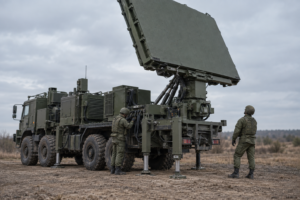
The same trade-off shows up on land. Counter-battery systems exist because the radar that finds it while the shell is still climbing also radiates energy that the other side can locate. Any sensor that emits can be heard.
What passive sonar actually hears
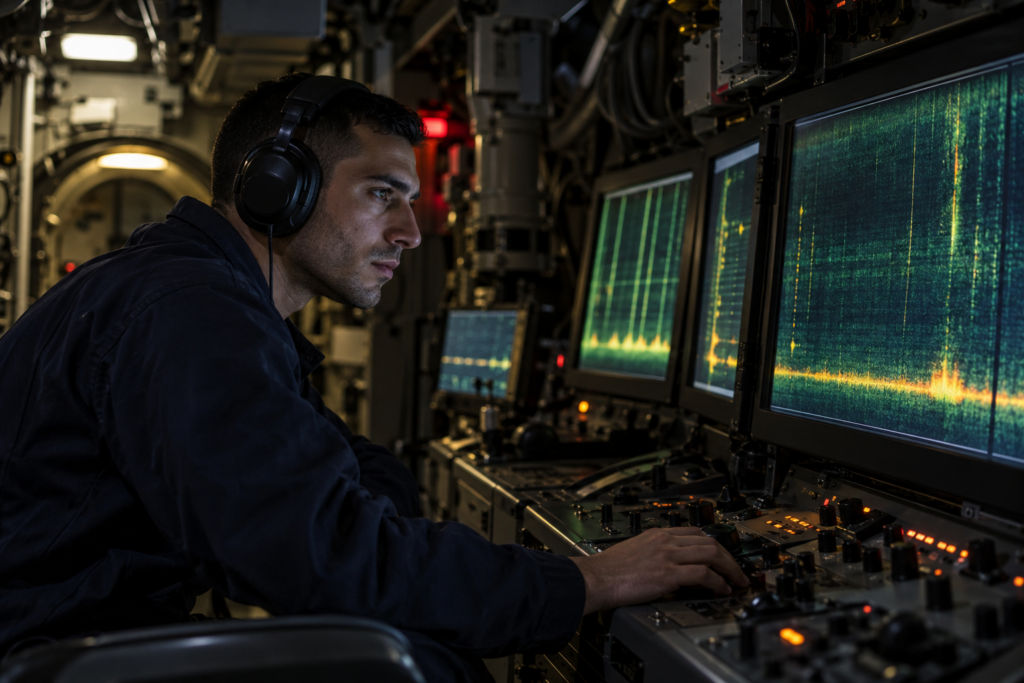
A passive array never transmits. It collects the sound other vessels make and lets operators and software sort it out. That sound comes from a few predictable places:
- Propeller cavitation: tiny bubbles that form and collapse on the blades, louder at high speed and in shallow water
- Machinery tones from pumps, generators and gearboxes, often at fixed frequencies that can identify a class of ship
- Flow noise as water rushes past the hull at speed
- Transient sounds, such as a dropped tool, a hatch closing or a torpedo tube flooding
Those fixed machinery tones matter most. A trained analyst can match a set of frequencies to a specific type of vessel, sometimes to an individual ship. That is why quieting programs mount machinery on raft structures with resilient mounts and why submarine crews move slowly. Silence is armor.
Active and passive side by side
Passive has one real weakness. Listening gives a direction, not a distance. Operators fix range by tracking how the bearing changes while their own boat maneuvers, a slow process called target motion analysis. It can take many minutes.
The ocean bends the sound
Seawater is not uniform. Temperature, pressure and salinity change with depth, and each change alters the speed of sound. Where warm surface water meets colder water below, the thermocline, sound bends instead of traveling straight. That creates shadow zones a sonar cannot reach.
Submarines use this. A boat sitting below the layer can be nearly invisible to a ship hull sonar above it. Navies answer by lowering sensors into the water: towed arrays trailed on long cables behind ships and submarines, dipping sonars lowered from helicopters, and sonobuoys dropped from patrol aircraft. Each puts an ear on the far side of the layer.
The final stage is where active returns. Once a boat commits to an attack, a precise range is worth the noise, and the target then has seconds to react with countermeasures like the ones described in the modern torpedo defense system. The logic is the same one that drives the fight over heat, radio and radar returns above water: whoever controls their own signature gets the first shot.
For the full technical background, the Wikipedia entry on sonar covers the physics and history. Next time a film submarine pings its way through an attack, count how many seconds the enemy had to hear it coming.
More articles you may like
- Camouflage nets stopped working: the fight is now over heat, radio and radar returns
- The fuel truck decides the battle, not the tank at the front
- Artillery is not killed by armor, it is killed by the radar that finds it while the shell is still climbing
- One interceptor cannot cover the sky: why modern air defense is built in layers
- A tank’s thickest armor now weighs almost nothing and fires back
- The cheap drone that kills a tank: how loitering munitions broke the cost-per-kill math