The fuel truck decides the battle, not the tank at the front
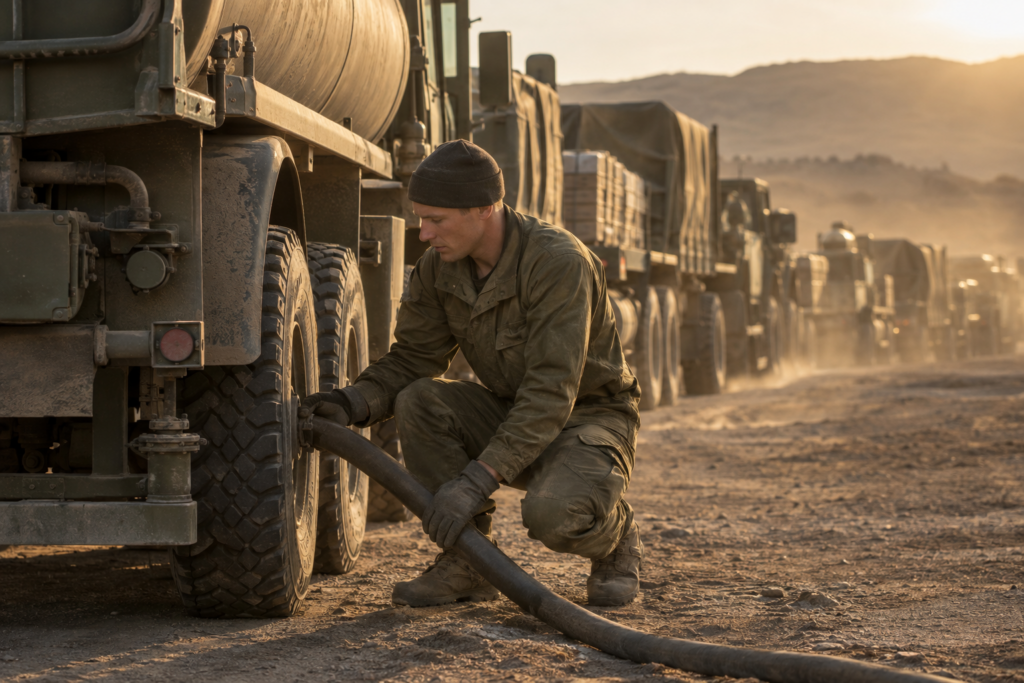
Military logistics and the supply column
In short: a modern brigade burns fuel and ammunition faster than it can be resupplied over a contested road, so the limiting factor in a campaign is the supply column, not the vehicle count. Planners now treat resupply nodes as primary targets and primary vulnerabilities. If you want to judge an army’s real reach, count its tankers and its transport, not its turrets.
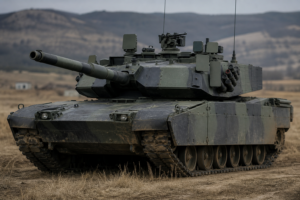
Public analysis of ground warfare fixates on platforms. Armor thickness, missile range, the number of tanks in a parade. The uncomfortable arithmetic sits one layer behind that. A main battle tank consumes several hundred litres of fuel per hundred kilometres, and an armored battalion in contact can empty its ready ammunition in a single day of intense fighting.
קראו גם: Artillery is not killed by armor, it is killed by the radar that finds it while the shell is still climbing · One interceptor cannot cover the sky: why modern air defense is built in layers · A tank’s thickest armor now weighs almost nothing and fires back
The ratio nobody puts on a poster
For every soldier firing a weapon, a mechanized force needs several more moving fuel, water, spare parts and rounds. That ratio has grown, not shrunk, as platforms became more capable. A vehicle with a thermal sight, an active protection suite and a digital fire control system needs power, calibration and technicians. Capability arrives attached to a maintenance bill.
Precision changed the shape of the bill rather than the size of it. Guided rounds cut the number of shells needed per target, which is exactly why one precision missile can outperform a barrage, but each round costs more and needs cleaner handling, storage and data. Fewer pallets, more expensive pallets, tighter tolerance for loss.
What a day of fighting actually consumes
Read the right-hand column again. Almost none of those constraints are solved by buying another combat vehicle. They are solved by trucks, cranes, generators, road engineers and people who can diagnose a gearbox at night.
Why the rear became the front
Cheap air attack collapsed the old assumption that fifty kilometres behind the line meant safety. A small loitering weapon costing a few thousand dollars can destroy a fuel tanker worth far more and, more importantly, stop an entire column on a single road. That economics problem is the same one described in the cost-per-kill math of loitering munitions, applied to soft targets instead of armor.
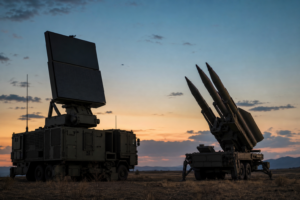
Defending that traffic is expensive in its own currency. Point defense over a logistics hub consumes interceptors that the manoeuvre force also wants, and interceptor stocks are finite, which is why air defense is built in layers rather than around one system. Every missile spent protecting a fuel dump is a missile unavailable elsewhere.
What planners now measure
- Days of supply held forward, not total national stockpile. Ammunition in a depot four hundred kilometres away is a statistic, not a capability.
- Number of usable routes to each brigade, including bridge weight limits. One road is a single point of failure.
- Mean time to repair for the most common drivetrain fault, measured in the field rather than at a workshop.
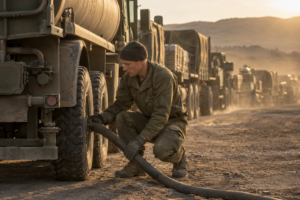
- Fuel handling capacity per hour at each node, since pump rate often caps a convoy before fuel volume does.
- Dispersal distance between stored pallets, which turns one lucky strike into a small loss instead of a catastrophic one.
The same logic governs sensors and jammers. Electronic support gear needs power and spares, and a degraded navigation environment forces more ground movement, a knock-on effect visible in how military logistics doctrine now plans for route improvisation as the default rather than the exception.
Next time a force structure is announced, skip the vehicle count and ask two questions: how many heavy transporters does it own, and how many trained mechanics per company. The answers predict staying power better than any armor figure.
מאמרים נוספים שיעניינו אתכם
- Artillery is not killed by armor, it is killed by the radar that finds it while the shell is still climbing
- One interceptor cannot cover the sky: why modern air defense is built in layers
- A tank’s thickest armor now weighs almost nothing and fires back
- The cheap drone that kills a tank: how loitering munitions broke the cost-per-kill math
- A bigger warhead is the wrong metric, accuracy is what decides the strike
- GPS is not a utility. It is a whisper that a jammer can shout over.