Night vision goggles cannot see in the dark. They need the light you cannot see
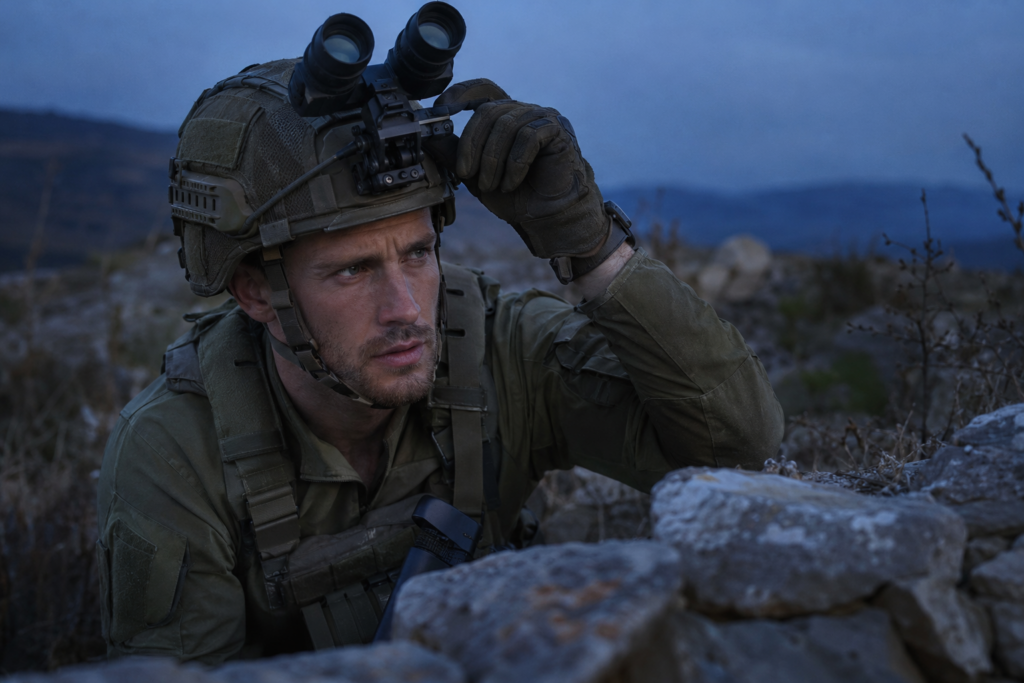
night vision vs thermal imaging
In short: classic night vision goggles do not create sight from nothing. They amplify faint starlight and moonlight thousands of times, which means total darkness defeats them. Thermal imagers work on a different principle, reading heat instead of light, and modern armies increasingly fuse the two into one device.
The movie version of night vision is a soldier switching on goggles in a pitch-black room and seeing everything in green. Real image intensifiers would show that soldier almost nothing. The device is a light amplifier, and a sealed room with zero light gives it nothing to amplify.
Read also: The Merkava’s engine sits in front on purpose: it is part of the armor · The loudest thing a submarine can do is look for you · Camouflage nets stopped working: the fight is now over heat, radio and radar returns
How an image intensifier actually works
Light enters the lens and hits a photocathode, which converts photons into electrons. Those electrons are multiplied, then slammed into a phosphor screen that glows. The operator looks at the screen, not at the world.
The first generation, fielded in the 1960s, needed moonlight to be useful. Second-generation tubes added a microchannel plate, a disc riddled with millions of tiny channels that multiply electrons as they bounce through. Third generation switched to a gallium arsenide photocathode, which is far more sensitive in near-infrared light.
Why green? The human eye separates more shades of green than any other color, so a green phosphor shows more detail with less fatigue. Newer tubes use white phosphor instead, producing a black-and-white image.
Thermal is a different sense entirely
A thermal imager ignores visible light completely. It reads long-wave infrared radiation, the heat every object gives off. A warm engine, a person, a recently fired barrel, tires that just stopped rolling: all of them glow against cooler ground.
That makes thermal useful in total darkness and through smoke or light fog. It is also the main reason camouflage nets stopped working against modern sensors. Thermal has its own blind spot, though. Ordinary glass blocks long-wave infrared, so a thermal sight cannot see through a car windshield.
The illuminator problem
To see in a dark building, an intensifier user switches on an infrared illuminator, essentially a flashlight the naked eye cannot see. The catch is obvious. Any opponent with their own goggles sees that beam as a bright searchlight pointing straight at its owner.
This is why night fighting became a contest of sensors. Once both sides own goggles, being the one who emits anything becomes a liability. The same logic now applies to drones. Small quadcopters and loitering munitions carry cheap thermal cameras, so a vehicle with a hot engine is visible at night from hundreds of meters up.
Why armies now fuse both
Each technology covers the other’s weakness. Fusion goggles overlay a thermal outline on top of an intensified image: the soldier sees the room in detail and a warm figure behind a bush lights up. The US Army’s ENVG-B is one fielded example of this approach.
- Intensifiers stay lighter, cheaper and better for driving and reading terrain.
- Thermal finds people and vehicles that are hidden or still.
- Fusion costs more and draws more battery power.
- Vehicle crews get the same mix through sights, alongside protection like active armor systems that also rely on sensors.
The technical background on tube generations is laid out in the Wikipedia entry on night-vision devices.
Next time a film shows green goggles in a sealed basement, check for a light source in the shot. If there is none, the hero is looking at a dark screen.
More articles you may like
- The Merkava’s engine sits in front on purpose: it is part of the armor
- The loudest thing a submarine can do is look for you
- Camouflage nets stopped working: the fight is now over heat, radio and radar returns
- The fuel truck decides the battle, not the tank at the front
- Artillery is not killed by armor, it is killed by the radar that finds it while the shell is still climbing
- One interceptor cannot cover the sky: why modern air defense is built in layers