The cheap drone that kills a tank: how loitering munitions broke the cost-per-kill math
Loitering munitions: why cheap drones rewrote the battlefield math
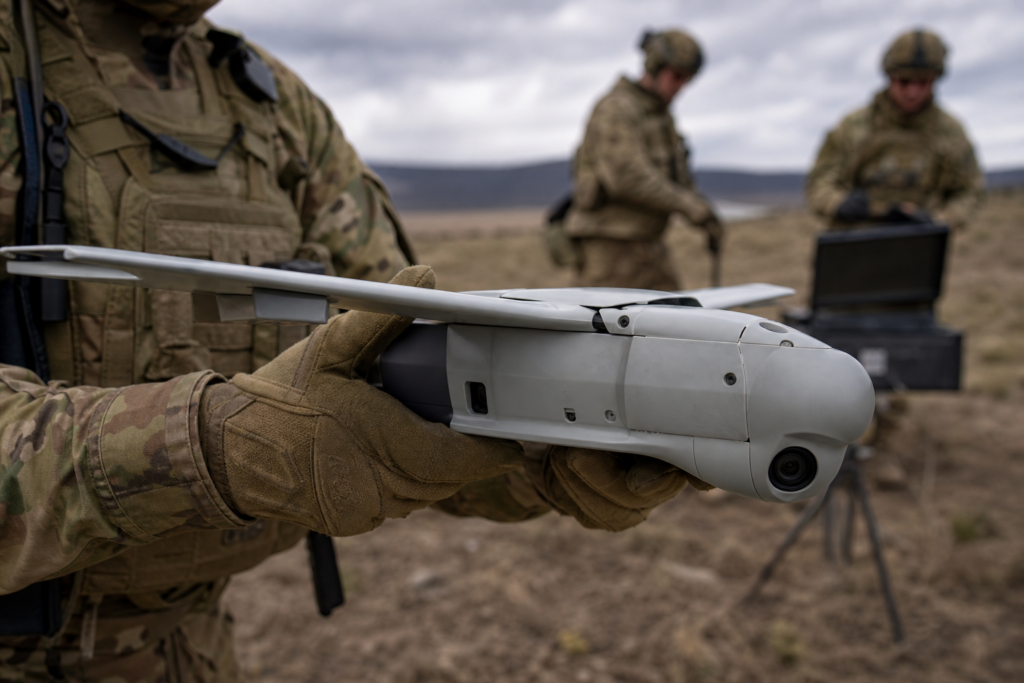
In short: A loitering munition is a small guided drone that hunts a target and then dives into it. Costing tens of thousands of dollars, it destroys tanks and radars worth millions, so the side with cheaper precision now sets the tempo of the fight.
For decades the logic ran one way: a bigger and more expensive missile beats a cheaper one. On the battlefields of 2022 to 2025 that assumption collapsed. Loitering munitions trade warhead mass for patience and pinpoint aim, and the question of who can afford to keep firing has flipped in favor of the cheaper shooter.
קראו גם: A bigger warhead is the wrong metric, accuracy is what decides the strike · GPS is not a utility. It is a whisper that a jammer can shout over. · More firepower does not mean more effectiveness: how one precision missile beats a barrage
What a loitering munition actually is
Call it the weapon that waits. A loitering munition takes off, circles a search area for minutes or hours, finds a target with an operator or onboard seeker, then crashes into it as the warhead. The AeroVironment Switchblade 300 weighs about 2.5 kg and carries a charge closer to a grenade than a bomb. It still kills, because the whole design bets on accuracy over warhead size: a small charge placed on the thin roof armor of a tank does what a far heavier warhead once needed to do from a blunter angle.
The Iranian Shahed-136 sits at the other end. It hauls a roughly 40 kg warhead across 1,000 km or more, flies a preset route, and arrives cheap enough to launch in swarms. Russia’s Lancet-3 splits the difference: a 3 kg charge, a range near 40 km, and a price around $35,000 per airframe.
The cost-per-kill math that changed everything
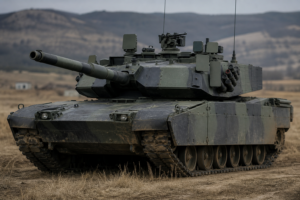
Here is the inversion. A single loitering munition costing $20,000 to $60,000 can destroy a main battle tank valued at $5 million or a radar worth far more. Compared with man-portable missiles such as the Javelin at roughly $175,000 per round, the loitering drone is cheaper and lets the operator confirm the target before committing. The defender who answers each $30,000 drone with a $3 million interceptor loses the exchange even when every shot hits.
Why persistence beats speed
A cruise missile is a one-way sprint. A loitering munition is a stakeout. The Rafael Spike Firefly can hover over an urban block, peek behind a wall, and wait for the target to expose itself before the operator commits. IAI’s Harop stretches that patience to six hours or more, orbiting until an enemy air-defense radar switches on, then homing on the emission. Speed matters less when the weapon can simply outlast the target’s attempt to hide.
That patience has a weak point. The guidance link. Both sides now pour resources into GPS jamming and radio interference to sever the drone from its operator or its satellite fix. The countermeasure race has pushed designers toward optical target recognition and fiber-optic tethers that no jammer can touch.
What it means for defense planning
The cheap-drone logic reshapes procurement, not just tactics. Budgets built around a few exquisite platforms look fragile against thousands of expendable ones.
- Cost-per-kill now favors mass. A $5 million tank should not be defended by burning $3 million interceptors on $30,000 threats.
- Layered short-range defense, guns and electronic warfare, matters more than another long-range missile battery.
- Stockpile depth beats unit sophistication. You need thousands of rounds, not dozens.
- Soft-kill options such as jamming and spoofing are cheaper per engagement than any physical interceptor.
- Domestic production lines matter, because a war of attrition is won by whoever can build faster than the enemy can shoot.
Reference on definitions and system history: loitering munition.
The lesson for any planner is blunt: count your magazines, not your marquee weapons, and price every defense against the cheapest drone that can defeat it.
מאמרים נוספים שיעניינו אתכם
- A bigger warhead is the wrong metric, accuracy is what decides the strike
- GPS is not a utility. It is a whisper that a jammer can shout over.
- More firepower does not mean more effectiveness: how one precision missile beats a barrage
- Not the prime minister, not just ceremonial: what the President of the State actually does
- Spike SR is a short range missile that is hand launched.
- An Overview of the Modern Torpedo Defense System