A fighter pilot’s most useful radar often belongs to someone else’s aircraft
Link 16 tactical data link
In short: Link 16 is the NATO data link that lets jets, ships and air defense batteries share one live picture of the battlespace. It means a pilot can see and engage a target without switching on their own radar, which changes how air combat is actually fought.
The popular image of air combat is a lone pilot hunting with the radar in the nose. That image is decades out of date. In a modern air force, the jet that fires a missile is often not the one that found the target.
Read also: Night vision goggles cannot see in the dark. They need the light you cannot see · The Merkava’s engine sits in front on purpose: it is part of the armor · The loudest thing a submarine can do is look for you
The glue is Link 16, a tactical data link defined in NATO’s STANAG 5516 and the US standard MIL-STD-6016. It carries positions, tracks, orders and short text messages between aircraft, ships and ground units in near real time.
What actually travels over the link
Link 16 does not send radar video. It sends compact binary messages, the J-series, each with a fixed meaning. One group of messages reports where every friendly unit is and who it is, called Precise Participant Location and Identification. Another carries surveillance tracks. Others handle weapons coordination, aircraft control and electronic warfare.
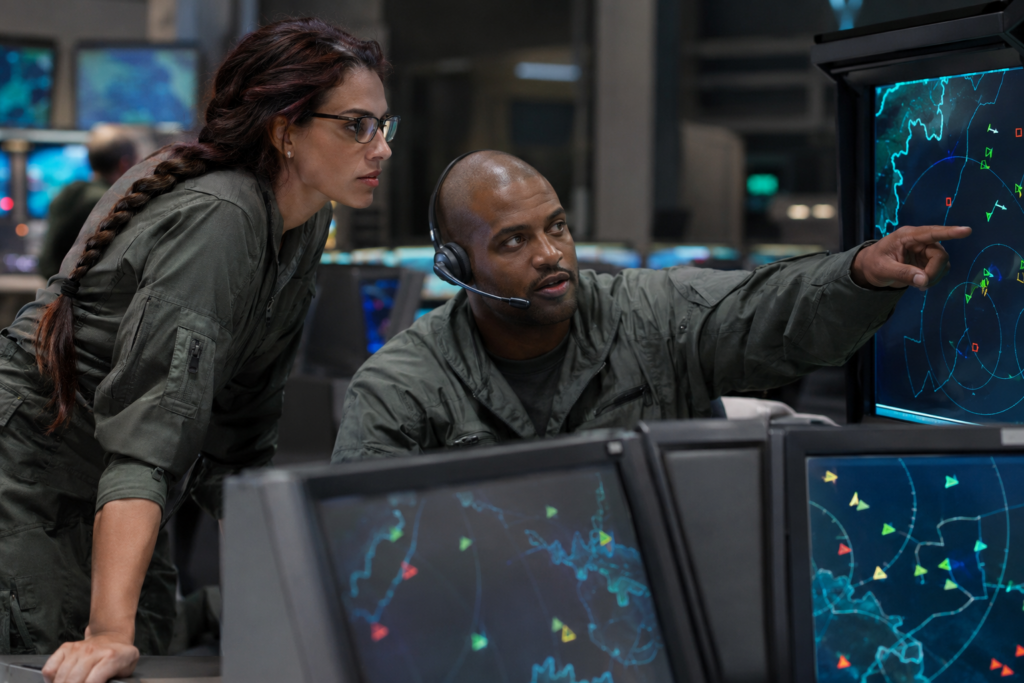
The result is a shared map. An E-3 Sentry orbiting far behind the front can detect a target, and a pair of F-16s closer in will see it on their displays with their own radars still silent. Silence matters. A radar that transmits is a beacon for the enemy’s warning receivers.
How it survives jamming
The link works in the 960 to 1,215 MHz band, the same slice of spectrum civil aviation uses for navigation aids. It is a line-of-sight system, so ground stations and relay aircraft extend its reach.
Two design choices make it hard to disrupt. First, it uses time-division access: every terminal gets assigned time slots of 7.8125 milliseconds, 1,536 of them in each 12-second frame, so nobody talks over anyone. Second, each transmission hops rapidly across 51 frequencies, which forces a jammer to spread its power thin. Anyone who has read about how a jammer can shout over a GPS signal will see why that hopping is the whole point.
Typical data rates are modest: 31.6, 57.6 or 115.2 kilobits per second. Even the top rate is a fraction of a basic phone data connection. It does not need to be faster, because the messages are tiny.
Link 16 compared with what came before and after
That last row explains a quirk. The F-35 carries Link 16, yet it often prefers its own directional link with other F-35s, because an omnidirectional broadcast can give away a stealth aircraft’s presence.
Why ground air defense depends on it
Link 16 terminals sit in fighters, frigates and missile defense systems, including Israel’s Arrow and the European SAMP/T. This is what makes modern air defense built in layers possible: a long-range radar hands a track to a battery hundreds of kilometers away, and an interceptor launches at a target the launcher’s own radar has not yet seen.
The weak spot is the same one that broke the old camouflage nets. Any radio emission is a signature, and the fight over heat, radio and radar returns includes data links too. An enemy that cannot read Link 16 can still locate where it is transmitting from.
- Data links turn separate sensors into one network, so the shooter and the spotter can be different platforms.
- Frequency hopping and fixed time slots make jamming expensive, though not impossible.
- Line-of-sight physics means relay aircraft and satellites are part of the system.
- Stealth aircraft limit broadcasts and lean on directional links to stay hidden.
The technical details, including the full list of platforms, are summarized in the Link 16 entry on Wikipedia.
Next time a news report counts fighter jets or missile batteries, ask a different question: how many of them share the same picture? A smaller force on one network can see and strike faster than a bigger one where every radar works alone.
More articles you may like
- Night vision goggles cannot see in the dark. They need the light you cannot see
- The Merkava’s engine sits in front on purpose: it is part of the armor
- The loudest thing a submarine can do is look for you
- Camouflage nets stopped working: the fight is now over heat, radio and radar returns
- The fuel truck decides the battle, not the tank at the front
- Artillery is not killed by armor, it is killed by the radar that finds it while the shell is still climbing